


A High Selic Rate Doesn't Protect Wealth on Its Own: What the FGV Study Says About Taking Part of Your Wealth Abroad

The question the study answers
With the Selic at an elevated level, the dominant intuition among Brazilian investors is a comfortable one: if the CDI pays well, why leave the real? The study "Going abroad is essential: why a high Selic rate does not fully protect Brazilian wealth" ("Ir para o exterior é fundamental"), by professors Claudia Yoshinaga, Francisco de Castro Junior, Ricardo Rochman and William Eid Junior of FGV's Center for Finance Studies (FGVcef), published in September 2026, attacks that intuition with a direct thesis: high interest pays for the country's risk; it does not eliminate it. Those who keep all their wealth in reais because of the nominal return are, in practice, concentrated in that risk[1][2].
This article organizes what the study shows in verifiable numbers, what it does not say, and which questions are worth taking to the decision-makers' table.
The R$100 test: the same investment, three yardsticks
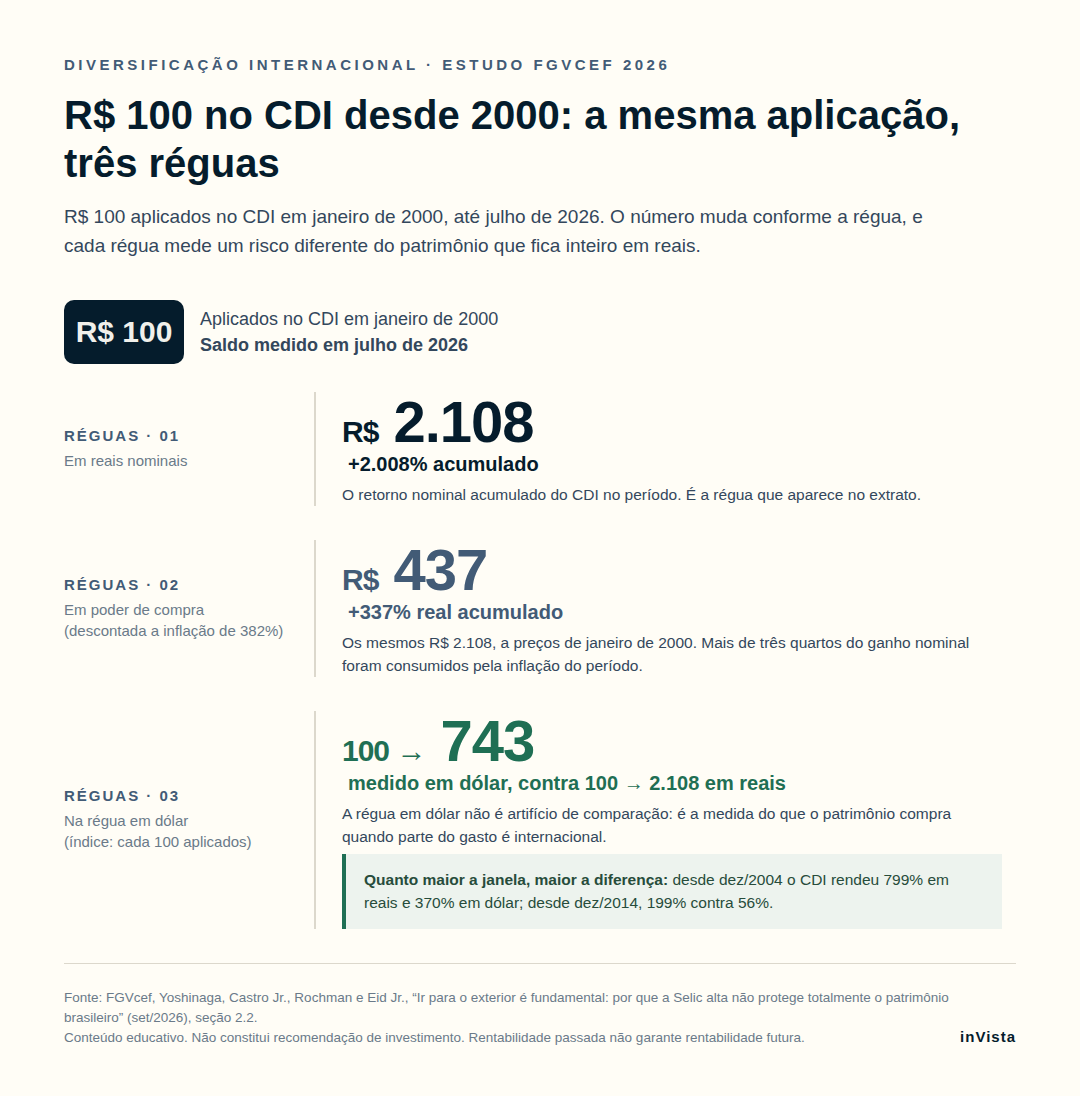
The study's central experiment is simple to state. R$100 invested in the CDI in January 2000, at the start of the floating exchange rate and inflation-targeting regime we still live under, through July 2026:
- In nominal reais: the cumulative return of 2,008% lifts the balance to approximately R$2,108.
- In purchasing power: inflation over the period was 382%. Prices multiplied by almost five. Net of inflation, the final balance is equivalent to about R$437 in January 2000 prices, a cumulative real return of approximately 337%. More than three quarters of the nominal gain was consumed by inflation.
- In dollar terms: the same investment, measured in dollars, returned about 643% over the period (each 100 became 743), versus 2,008% in reais.
Lengthening the windows shows the same movement. Since December 2004, the CDI returned 799% in reais and 370% in dollars; since December 2014, 199% versus 56%. The dollar yardstick, the authors note, measures what wealth buys when part of spending is international (education, travel, durable goods, the price of anything quoted abroad).
What the crises show: the difference is not the fall, it is the recovery
The study compares the maximum drawdown, in real terms, and the recovery time of the Brazilian and US stock markets in five stress episodes:
| Episode | Brazilian stock market | Recovered in | US stock market | Recovered in |
|---|---|---|---|---|
| 2002 election | −41.3% | 13 months | −13.9% | 3 months |
| 2008 financial crisis | −50.9% | has not recovered | −36.7% | 50 months |
| Recession and impeachment, 2015 | −42.5% | 23 months | no decline | not applicable |
| Pandemic, 2020 | −37.2% | 14 months | −3.5% | 2 months |
| Monetary tightening, 2022 | −30.6% | 43 months | −22.3% | 22 months |
What separates the two markets, the authors stress, is the capacity to recover rather than the depth of the declines. The US market recovered from every episode, including 2008; the Brazilian one did not recover precisely from the externally originated shock: eighteen years later, it remains 13% below the real level of May 2008. And the asset perceived as risk-free also loses: the Brazilian floating-rate investment lost 9.2% of purchasing power between July 2020 and April 2022, with no default and no price fluctuation; inflation simply ran above interest for twenty-one months in a row.
Income that falls without any default
The third hole in the notion of safety is reinvestment risk. The 12-month cumulative CDI has ranged, since 2000, from 24.2% a year to 2.1% a year. The study's example makes the mechanism concrete: R$2 million invested with the CDI at 14% generates about R$280,000 gross per year; if the CDI falls to 10%, the same investment generates R$200,000, a 28.6% reduction in income, with no default and no nominal loss of principal. The authors' practical conclusion: CDI-linked investments are useful for liquidity management and can be part of a long-term portfolio, but on their own they do not guarantee stable income for many years. Between December 2019 and July 2021, the CDI stayed below 5% a year.
What changes depending on the starting window
The study has the rare virtue of showing what would overturn its own headline. Redoing the central comparison against the highest-risk US credit and changing only the starting year, the advantage of Brazilian fixed income swings from +2.4 points a year (starting in 2003) to −3.9 points a year (starting in 2012). By subperiod, the real return on Brazilian floating-rate fixed income went from 19.9% a year in 1995–1999 to 3.8% in 2010–2019 and 3.9% in 2020–2026.
The authors do not conclude that the CDI always loses. For them, the result depends on the horizon, and no one chooses the window in which they will live. Reporting only the thirty-year compound rate projects a parameter of one specific monetary regime as if it applied to any regime. That is why the right question stops being "which asset won in the past?" and becomes "how is the position built over time, and at what cost?".
Three products are not three risks
The study devotes a section to a common misunderstanding: the diversified portfolio that diversifies nothing. A portfolio can hold many products and remain concentrated in the same risk factors: three different investments are not three independent risks; they can be three forms of exposure to the same economy, the same fiscal environment and the same currency[1][2]. To reduce this common origin, it is necessary to incorporate assets whose results depend on other economies, currencies and issuers.
And there is a counterintuitive point for those who merely "migrate" their portfolio: changing environment requires changing the composition criterion, not just the address of the assets. The Brazilian investor who takes a portfolio abroad without revisiting its composition tends to replicate there a fixed-income-heavy allocation that, in that lower-interest-rate environment, does not play the same role.
What the study does not say
The limits of the study and of this reading:
- It is not a product recommendation. The study argues for internationalizing part of wealth; it does not size how much, does not recommend vehicles and does not promise results. The allocation decision is individual and depends on objectives, horizon, taxation and access.
- High interest is a fact, and it is real compensation. The real return on Brazilian fixed income was positive in every subperiod of the study's Table 5.4, including 3.9% a year in 2020–2026. The argument is about risk concentration, not about the CDI being useless.
- The exchange rate may reverse, or not. The study analyzes the real exchange rate in four of the five episodes in the table above (2002, 2008, 2015 and 2020). In two of them, the real exchange rate returned to its prior level; in the other two, the depreciation stayed. Those who buy dollars at the peak of a crisis can lose money if the exchange rate reverses; the study itself warns that waiting for a favorable exchange rate to internationalize is to postpone protection indefinitely.
- Going international has its own costs and rules. The study maps what internationalization solves and what it does not regarding regulatory and tax risk: taxes, filings, structure costs and qualified access are part of the equation.
- The opinion is the authors'. As the FGV portal itself notes, statements by members of the Foundation represent the authors' opinions, not an institutional position[1].
Questions to take to the table
- What share of my standard of living depends on goods and services quoted in foreign currency? It is the yardstick that sizes the exposure that already exists, before any decision.
- If the CDI halves tomorrow, can my income withstand it, and for how long? Reinvestment risk does not show up on the statement until the rate changes.
- Does my portfolio have three products or three independent sources of risk? The answer lies in the factors behind the assets, not in the number of lines.
- Am I internationalizing out of discipline or as a bet on the exchange rate? The study is explicit: protection is built with consistency, not by picking the moment.
- At what cost? Taxation, structure, liquidity and access: what internationalization charges to deliver what it promises.
Conclusion
The strength of the FGV study, which drew press coverage[3], lies in replacing a flawed question with a useful one. "CDI or abroad?" presumes the choice is between return and protection. The data show something else: a high nominal return is, in part, the price of risk concentrated in one economy and one currency, and protection is built with real diversification discipline, not by waiting for a better exchange rate. Internationalizing part of one's wealth, the authors conclude, is not a gesture against the country; it is the recognition that no wealth should depend entirely on a single economy. This holds for any economy: what changes is the degree[1][2].
If internationalizing your wealth is on your agenda, the way forward is to talk about how to do it and at what cost. inVista works through this discussion with families and investors, including through funds with exposure to international assets.
Disclaimer
This content is for informational and educational purposes only and does not constitute an offer, solicitation, recommendation or investment advice. Past performance does not guarantee future results. Historical data cited refer to the FGV study indicated in the sources, within its analysis windows. Before any decision, assess your objectives, horizon and risk profile and seek guidance from a qualified professional.
Sources
[1] FGV, institutional news "Estudo indica que investimentos não devem depender de uma única economia" (09/21/2026): https://portal.fgv.br/noticias/estudo-indica-que-investimentos-nao-devem-depender-de-uma-unica-economia
[2] FGV, full study "Ir para o exterior é fundamental: por que a Selic alta não protege totalmente o patrimônio brasileiro" (Yoshinaga, Castro Jr., Rochman and Eid Jr., FGVcef, September 2026, 66 pages): https://portal.fgv.br/sites/default/files/uploads/estudo_investimentos_no_exterior_v20260909-1.pdf. Figures cited: sections 1.1, 2.2, 2.3, 3, 3.2, 4.3, 5.3, 5.4 and 5.5 and Tables 1.1, 5.2, 5.4 and 5.5.
[3] TrendsCE, "Estudo da FGV destaca importância de diversificar patrimônio no exterior" (09/23/2026): https://www.trendsce.com.br/2026/09/23/estudo-fgv-investir-no-exterior-protecao-patrimonio/
