


The U.S. real estate reset and private credit opportunities for dollar-denominated assets

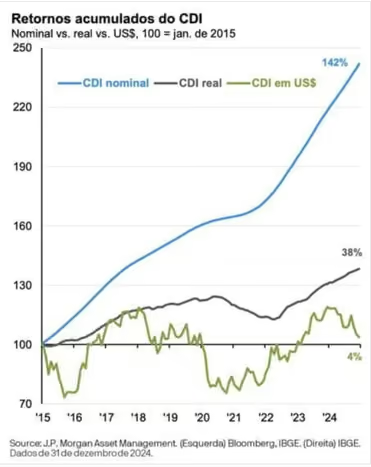
For decades, many Brazilian investors, despite seeing satisfactory returns in reais, have faced a silent but corrosive phenomenon: the erosion of their wealth in dollar terms. The CDI, which at times seemed like a safe haven, revealed only modest gains when translated into a hard currency. As illustrated in the following J.P. Morgan analysis, a dollar-based investment yielding 8.5% per year could have generated a return approximately 56 times higher than the CDI converted to hard currency over the last ten years¹. Diversifying into dollars, therefore, has moved from being an option to a vital strategy for the long-term preservation of wealth.
Within this landscape of diversification, a massive market is emerging with strength: private real estate credit in the United States. With an annual volume of over $400 billion and a total size exceeding $3.7 trillion, this is a sector of constant opportunity, largely shielded from the fluctuations of the property buying and selling cycle, and focused on financing real estate operations backed by tangible collateral.
However, after a period of price adjustment, the U.S. real estate market is experiencing a recalibration that offers a more rational entry point for capital. As highlighted in the recent report Why Real Estate in 2026?, by Apollo Global Management,capitalization rate (cap rate) spreads have normalized, reflecting a market that has already readjusted and is no longer priced at peak valuations². This means that current valuations are more aligned with historical averages, offering a more balanced risk-return profile.
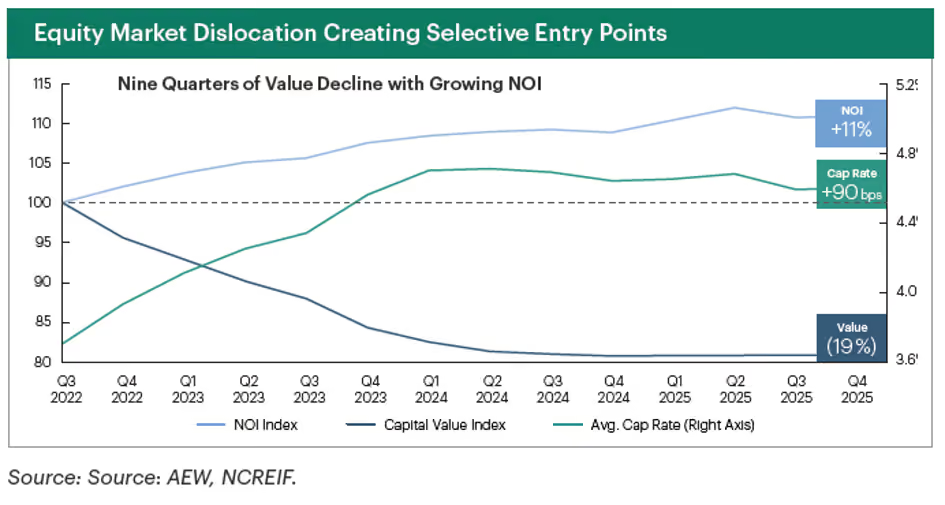
Unlike past cycles, the current adjustment was not caused by excessive leverage, but by an interest rate shock. While prices corrected, the operational fundamentals (NOI) of U.S. assets grew by approximately 11% over nine quarters, demonstrating rare resilience³. The net operating income of properties in the United States increased while capital values adjusted to higher interest rates, suggesting that the correction was driven primarily by the cost of capital—rather than a deterioration of the asset fundamentals themselves.
A determining factor is the significant slowdown in new construction supply, compounded by rising costs for materials and labor. This environment of scarcity increases the value of existing assets and provides natural protection through "replacement cost." For the credit investor, this dynamic is fundamental, as it strengthens the tangible collateral of the operations: it becomes economically unfeasible to replicate the asset at the current market price, creating a "floor" of value that protects the loaned capital against sharp devaluations.
In this sense, U.S. private real estate credit funds act as lenders, providing capital for the development or acquisition of assets, with the property itself serving as collateral. The operations are carefully structured, with defined interest rates and terms. Capital protection is inherent, often with the tangible collateral significantly exceeding the financed amount, creating a robust margin of safety for the investor.
Historically, this asset class has demonstrated great resilience. When well-managed, private real estate credit strategies in the United States have the capacity to deliver consistent, low-volatility returns in dollars, even during periods of global uncertainty.This approach doesn't aim to be the fastest in a hot market, but it offers stability and security when uncertainty prevails, acting as a "high-performance rain tire" for your assets.
For Brazilian investors, accessing this strategy has become increasingly straightforward, with various options that include currency hedging mechanisms for those with liquidity in local currency, or direct access for those who already hold dollars, simplifying the journey toward international diversification.
In a world of growing uncertainty, the resilience of the U.S. real estate market, combined with a private credit thesis focused on capital protection, offers an additional, intelligent layer of portfolio diversification. It is not just about investing in dollars; it is about investing in security, predictability, and peace of mind.
¹Illustrative exercise by J.P. Morgan Asset Management.
²Apollo Global Management, “Why Real Estate in 2026?”, Mar. 2026. The estimates and projections cited reflect the author's views at the time of the report and are subject to change.
³Data from AEW and NCREIF, cited in the report "Why Real Estate in 2026?" by Apollo Global Management (Mar. 2026). Refers to NOI index growth over nine quarters.
LEGAL DISCLAIMER
This content is for informational and educational purposes only and does not constitute an offer, recommendation, or solicitation to invest, nor does it provide financial, legal, or tax advice. The opinions expressed reflect the author's views as of the date of publication and are subject to change. Past performance is not a guarantee of future results. All investments involve risk, including the potential loss of principal. Third-party data is presented in good faith and may not have been independently verified. Before investing, consult with qualified professionals and assess the suitability of these investments for your profile and objectives.
