


The Hidden Treasure: Why do wealthy Brazilians still ignore the potential of international real estate investments?

Over 10 years, the CDI rose 142%—but in dollar terms, this gain represented only 4%. Meanwhile, the global wealth of the ultra-wealthy has soared. This gap reveals an uncomfortable truth: wealthy Brazilians who concentrate their investments domestically are becoming poorer in relative terms.
In a global landscape of high interest rates and a growing search for consistent returns and portfolio diversification, I see a concerning gap among high-net-worth Brazilian investors: the underutilization of mature and highly effective international diversification tools, such as U.S. real estate private credit, Real Estate Investment Trusts (REITs), and, increasingly, Triple Net Lease (NNN).
As an expert, I ask: why, even with solid, predictable returns backed by real assets, do the wealthiest Brazilians continue to ignore these international options?
The Reality of Domestic Concentration
Concentrating exclusively on the Brazilian market carries a high and growing cost. While the global elite have expanded their fortunes, the Brazilian elite have seen their international purchasing power diminish. This phenomenon stems from "investment inflation": in the U.S., the cost of living has increased, but the value of assets such as real estate, stocks, and infrastructure has appreciated many times more. Without global exposure, Brazilian investors get richer in reais but poorer in dollars..
A JP Morgan study illustrates the problem: over a decade, the CDI rose 142%, but in hard currency, this equates to a mere 4%. In contrast, a dollar-denominated investment yielding 8.5% per year would have generated 56 times more return over the same period.
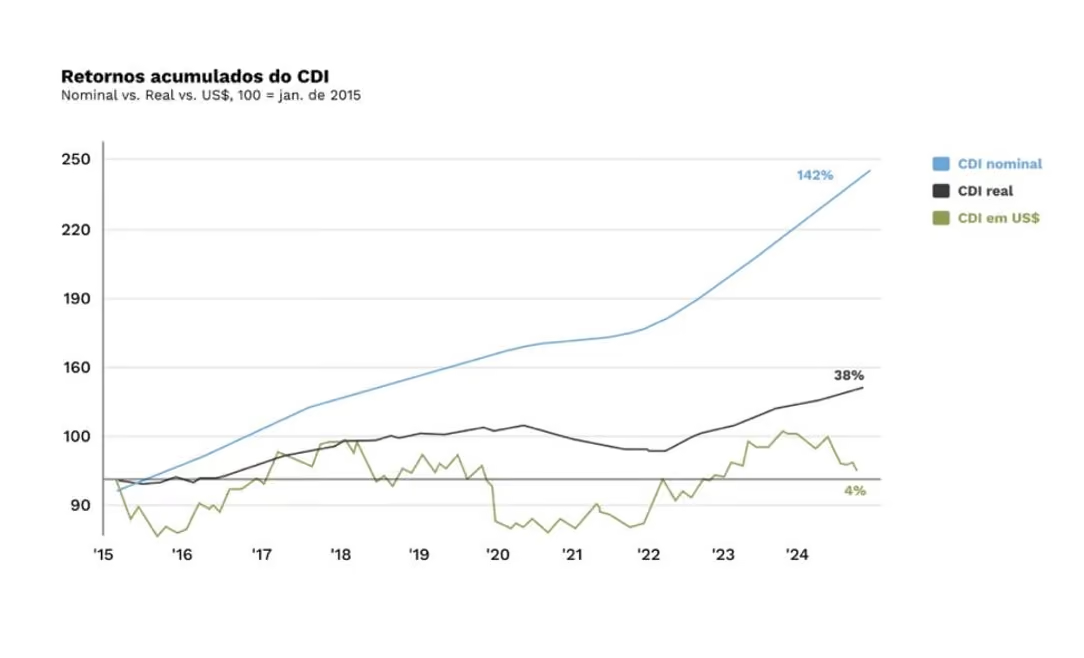
The conclusion is straightforward: even with high interest rates, keeping 100% of your capital in Brazil is risky and inefficient from a global perspective.
Real Estate Private Credit: The Solid Foundation of Diversification
We start with the foundation: Real Estate Private Credit. We have been operating in this segment for 6 years within a massive $3.7 trillion market that moves over $400 billion annually. This is where the most resilient part of a well-structured international portfolio is born. We operate as lenders, financing American entrepreneurs for the construction or acquisition of real estate assets, always with the property as collateral.
For every dollar lent, we hold a property as collateral valued at 1.5 to 2 times the investment made. All loans have defined interest rates, fixed terms, and structured adjustments. This design creates what we call asymmetric risk: the potential for loss is extremely low, while the return is stable and predictable. In an adverse scenario—such as default or liquidation—the value of the property tends to preserve or exceed the amount invested, keeping the capital protected. In other words: you have a structure built to absorb shocks while continuing to deliver returns.
Over 400 operations in 70 months:
- We have never lost capital: zero negative results
- Consistent returns: 9% to 11% per year in USD
- Predictable income: like clockwork, automatically reinvested
This predictability is fundamental to any international allocation strategy: you have a secure foundation upon which to build.
Triple Net Lease (NNN): Security of a Premium Asset + Capital Gains
The Triple Net Lease represents the natural evolution of a strategy after building a solid foundation with Private Credit. It is a model that combines contractual security, income stability, and exposure to capital gains—one of the most effective formulas in American real estate. In the NNN model, the tenant assumes all property expenses, such as taxes, insurance, maintenance, and common area charges. This reduces operational risk and turns rent into an extremely predictable income stream, often immune to the market's sharpest fluctuations.
Much of the market, however, adopts a more generic approach: standardized properties, such as fast-food chains, pharmacies, or convenience stores, often located in lower-income regions with tenants who have more sensitive credit risk. These assets work well for those seeking long-term contracts, but they rarely offer significant appreciation potential. They are properties that pay, but do not grow.
The inVista strategy takes a different path. Our focus is on mission critical assets, that is, properties essential to the tenant's operations, where the company not only occupies the space but depends on it to function.
These assets are typically built or deeply adapted according to the tenant's technical specifications, with internal investments that can reach tens of millions of dollars. They are located in dynamic markets with structurally low vacancy and an economic depth that sustains the asset's value over the long term. Furthermore, our tenants are global companies with some of the highest credit ratings in the world, which significantly increases the security of the operation.
Contracts provide clear protections from the outset—predefined annual adjustments, obligations assumed by the tenant until the end of the lease term, and the legal certainty typical of the U.S. real estate market. This creates a rare combination: dollar-denominated, highly predictable income with real potential for capital gains through cap rate compression or natural asset appreciation. It is a structure designed to perform well during stability and continue functioning even in more turbulent scenarios.
The track record proves this. Over the last six years, we have acquired 25 NNN assets with tenants such as Amazon, Microsoft, and AMD, all paying on time, in dollars, with obligations secured until the end of the contract, even in the event of termination. Of these investments, six have already been divested with an average IRR of 13.7% per year and an average cycle of just 28 months from entry to exit. It is the type of strategy that not only preserves capital but grows it consistently.
REITs: Broad Exposure and Liquidity
To complete a truly balanced international strategy, we enter the world of Real Estate Investment Trusts (REITs), the gateway to a global, mature, and highly diversified real estate market. REITs have existed since the 1960s and were created to transform institutional real estate into an accessible, liquid, and exchange-traded market. Today, they form a trillion-dollar ecosystem that brings together companies with advanced governance, professional management, and operations in sectors that go far beyond traditional commercial properties.
Contrary to what many Brazilian investors imagine, REITs are not just American versions of FIIs. They are complete corporate structures with CEOs, boards of directors, independent committees, and the capacity to operate, develop, finance, and reposition assets on a global scale. This maturity is reflected in the numbers: the REIT market has a capitalization more than fifty times larger than that of Brazilian real estate funds, allowing for a depth of liquidity and a diversity of sectors that simply does not exist in Brazil. It is possible to invest in data centers, advanced logistics, healthcare, multifamily residences, premium retail, digital infrastructure, and telecommunication towers—the true foundations of the contemporary economy.
This diversity and the professionalization of the sector create a very favorable dynamic for the investor. Instead of betting on a single physical asset, the investor gains exposure to broad portfolios with hundreds or thousands of properties distributed across different regions and economic cycles. Active management provides tactical adjustments that an individual owner could never make. And the daily liquidity of the market allows for increasing, reducing, or reallocating positions without the structural friction typical of traditional real estate. Risk is diluted by design, while the potential for gain remains linked to the natural appreciation cycles of strategic sectors—especially those driven by structural trends such as digitalization, population aging, and infrastructure growth.
Within an international diversification strategy, REITs play a fundamental role. While Private Credit provides stability and predictability, and NNN assets deliver wealth security with capital gains, REITs add the element of liquidity and dynamic exposure to the fastest-growing sectors in the world. They function as the living component of the portfolio: sensitive to market changes, yet anchored in real assets and operated by managers with decades of experience.
Investing in REITs means participating in resilient sectors, accessing companies with robust governance, and gaining exposure to long-term cycles that drive asset appreciation. In a rapidly changing world, this layer of strategic liquidity is what allows the investor to follow trends without sacrificing the solidity of real estate.
Why do wealthy Brazilians still ignore these investment vehicles?
I have identified the main obstacles:
- Lack of Knowledge and Access: Access to offshore products is perceived as complex, with a lack of education regarding the advantages of Private Credit, NNN leases, and international REITs. However, the democratization of these tools, facilitated by specialized asset managers, has significantly expanded access for Brazilian family and multi-family offices.
- Perceived Risk Aversion: There is a perception that investing abroad is riskier. However, geographic diversification is exactly the opposite—it is a risk mitigation strategy that protects wealth against local crises and provides exposure to more mature and resilient markets.
- Excessive Focus on the Local Market: Brazilian investors have a strong inclination to keep their investments within the country, ignoring opportunities in more mature, diversified markets with higher-quality assets.
- Bureaucracy and Taxation: The complexity of legislation for international investments can be an apparent deterrent. However, with specialized support, it is perfectly accessible and well-structured.
Conclusion
It is imperative that wealthier Brazilians understand that international diversification into "brick-and-mortar" assets is a strategic necessity for the preservation and growth of their wealth.
Private Credit offers a solid foundation—protection and stability in any scenario. NNN leases offer premium security with predictable income and capital gains. REITs complement this with broad exposure and liquidity. Together, these three theses represent the hidden treasure that the Brazilian elite continues to ignore.
Remaining isolated in the domestic market is synonymous with relative stagnation. Invest globally in "brick-and-mortar" assets to preserve and grow your wealth.
Disclaimer: This material is for informational purposes only and does not constitute an offer, solicitation to buy, or investment recommendation. Past performance is not a guarantee of future results.
inVista Real Estate Insights is a biweekly series by inVista Real Estate which offers strategic insights and reflections on the future of the real estate sector based on in-depth analysis and global market intelligence. Led by managers with 25 years of experience and a proven track record in over 23 countries, our newsletter is dedicated to investors seeking security and profitability, helping to build the future of the real estate market, brick by brick.
