


Essential Infrastructure with an Economic Moat: Why Data Centers Are a Multi-Year Opportunity

Different Drivers, Same Goal
Every commercial real estate sector has its own driver. Demand for multifamily properties is fueled by household formation and the chronic housing shortage in the United States. Retail demand is driven by consumer spending and the evolution of shopping habits across generations. Industrial demand follows supply chains, e-commerce, and inventory management. Office demand reflects corporate decisions regarding collaboration, productivity, and remote work.
Data centers are different. Their growth is not tied to family demographics, consumer confidence, or corporate workplace strategies. Instead, it is driven by the exponential expansion of digital workloads—cloud migration, artificial intelligence, and enterprise IT adoption. These are not trends that stop when GDP slows down. These are structural shifts in how economies and societies operate. That is what sets data centers apart. While other property types rise and fall with the cycle, data centers ride the wave of technological transformation, a force that intensifies every year..
Scarcity That Strengthens
Scarcity is at the heart of the matter. Across the United States, data center vacancy rates hover between one and two percent—levels unthinkable in most other asset classes. In Northern Virginia, the world's largest data center hub, that rate has reached 0.8%. Utilization rates remain above 90%. In most property types, such a tight vacancy rate would signal overheating or imbalance. In data centers, it reflects something else: capacity that is already committed, with demand still accelerating..
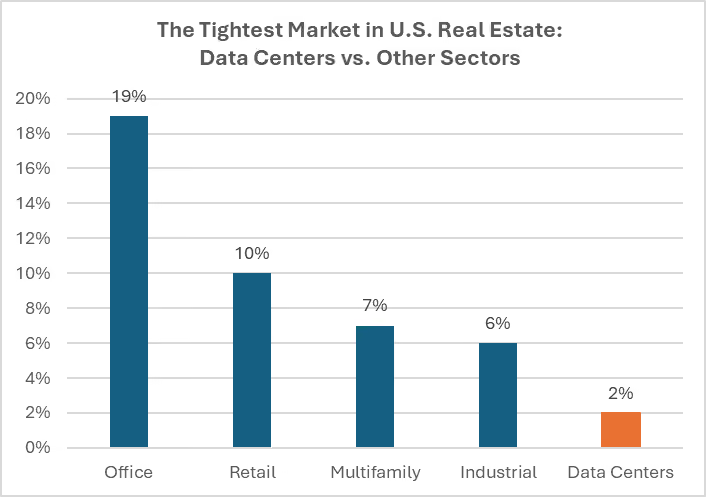
This demand is not optional. The workloads running inside these facilities are mission-critical. ¹Hyperscalers depend on them to deliver cloud services worldwide. Companies use them for secure storage, disaster recovery, and AI applications. Governments use them to operate everything from citizen services to defense programs. These tenants cannot postpone, relocate, or reduce their usage the way a retailer could close stores or an office tenant could downsize their space. In data centers, demand is structural and non-discretionary..
The Energy Bottleneck
If scarcity defines the story, energy is what cements it. The constraint on data center development is no longer simply land or capital—it is electricity.
Building a modern facility requires seven to twelve million dollars per megawatt of IT load. However, the biggest challenge is not the cost, but the ability to connect that facility to the power grid. In Northern Virginia, the wait time to obtain new power can stretch from three to seven years. In Dublin, regulators have imposed a de facto moratorium on new connections. Singapore has limited allocations so strictly that only a few megawatts remain available in the market.
This creates what can only be described as an energy moat. Landowners with sites already connected to substations hold an enviable position. They can lease space years in advance, at higher rents, with limited risk of competition. Unlike other property types, where new supply can quickly flood markets, data center capacity is constrained by physics and regulation. As AI workloads intensify, this moat isn't shrinking—it's widening.
Cash Flows You Can See
Scarcity and necessity translate directly into revenue visibility. Tenants in this sector sign exceptionally long leases, typically ten to twenty years, often committing to capacity that has not yet been delivered. In many markets, projects currently under construction are already pre-leased through 2027. This level of advance booking is virtually unmatched in the real estate market.
Other sectors offer stability, but their demand drivers are more cyclical. Multifamily rents can stagnate when local supply balances out. Retail leases can be renegotiated or vacated when consumer behavior shifts. Industrial rents rise and fall with global trade volumes. Data center leases, by contrast, provide predictable, high-credit-quality income streams for years into the future. For investors, they combine the stability of infrastructure with the growth of technological adoption—a rare combination in any asset class.
Different Demand Drivers
The contrast with other sectors is best understood not in terms of winners and losers, but in terms of demand drivers. Multifamily real estate thrives on demographics and the shortage of affordable housing. Retail adapts to consumer preferences, with prime locations emerging as experience-focused destinations. The industrial sector benefits from e-commerce, the reshoring of production, and the need for modern logistics networks. The office sector reflects constantly changing work strategies, with some sectors cutting space and others reconfiguring it for new collaboration models.
Data centers, however, are driven by digital transformation—a global and cumulative trend. Every company is migrating workloads to the cloud. Every ¹hyperscaler is scaling capacity for AI. Every government is digitizing citizen services and critical infrastructure. Unlike other drivers, this one is not cyclical. It is cumulative. Each new workload builds on the previous one, creating demand that intensifies year after year. This is what gives the sector both resilience in downturns and growth in expansions.
The Long Growth Runway
The most important element for investors is that this is not a one-year story. The ¹hyperscalers, by themselves, are on track to increase their capital expenditures from approximately $350 billion in 2025 to over $500 billion annually by 2030. By the end of the decade, nearly seventy percent of global data center demand will be tied to AI workloads.
This trajectory makes it clear that the current building cycle is not a peak. It is a foundationThe cranes rising now are delivering pre-leased capacity that will be fully absorbed long before the lights are turned on. Additional demand is already building years ahead. Few sectors in commercial real estate can claim such visibility, extending not just quarters ahead, but for an entire decade.
The Tools and Instruments
For public investors, access to this theme is available through a concentrated set of REITs. Digital Realty (DLR) is an established global company with one of the largest banks of powered land and the capacity to deliver multi-gigawatt campuses in the most constrained markets. Equinix (EQIX) is the dominant interconnection platform, where the network effect of collocated tenants creates loyalty and resilience. Iron Mountain (IRM), long known for paper storage, has built a growing data center business that diversifies cash flows and expands growth. American Tower (AMT), through its subsidiary CoreSite, offers a hybrid angle that connects towers and data centers, reflecting the convergence of digital infrastructure.
Each of these companies is positioned differently, but they all share the same underlying strength: access to scarce, powered capacity in markets where demand growth is guaranteed for years.
Barriers that Protect
No sector is exempt from risk. Power delays, regulatory scrutiny, and capital intensity are all real factors for data centers. However, these risks also serve to protect established companies. Delays limit new supply, reinforcing the advantage of those already connected. Regulation raises barriers to entry, favoring established players with strong relationships and scale. Capital requirements restrict competition to those with access to deep, liquid markets. In this way, the very challenges that could be seen as risks become reinforcements of the moat.
Essential and Enduring
Every real estate sector has its own story. Multifamily follows demographics. Retail follows the consumer. Industrial follows supply chains. Office follows workplace strategy. Data centers follow technology adoption. This story is not cyclical—it is structural. It is one of scarcity and necessity, of long-term contracts and visible cash flows, of demand that intensifies regardless of the economic landscape.
For investors, data centers are essential infrastructure with an energy moat. They offer resilience today and growth tomorrow. They are one of the few property types where scarcity and necessity align to create not just stability, but a multi-year opportunity that is still in its early stages.
¹Hyperscalers: Large cloud service providers (such as AWS, Microsoft Azure, Google Cloud, Meta) that operate at massive scale and with high elasticity.
inVista Real Estate Insights is a biweekly series from inVista Real Estate which, based on in-depth analysis and global market intelligence, offers strategic insights and reflections on the future of the real estate sector. Led by managers with 25 years of experience and a proven track record in over 23 countries, our newsletter is dedicated to investors seeking security and profitability, helping to build the future of the real estate market, brick by brick.
