


The $7 Trillion Question: Who Will Build the Backbone of AI?

By now, the numbers are familiar. The ¹hyperscalers are on track to spend more than $350 billion in 2025 alone on AI-related infrastructure. McKinsey projects that, by 2030, nearly $7 trillion in cumulative investment will be needed to support global data center capacity, with nearly 70% of that figure directly tied to AI workloads.
The build-out is irreversible. The real debate is about who will fund it—and what vehicles investors can use to participate.
The ¹Hyperscalers' Balance Sheets: Deep, but Not Infinite
At the heart of this story are the ¹hyperscalers themselves—Microsoft, Amazon, Google, and Meta. They have the balance sheets to lead and are already spending at unprecedented levels.
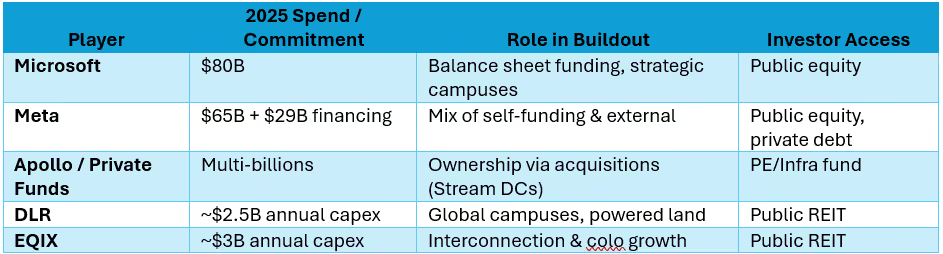
- Microsoft: $80 billion in Capex for FY25, much of it for AI-ready data centers.
- Meta: $65 billion in Capex for AI infrastructure in 2025, plus $29 billion in third-party financing for campuses in Louisiana.
- Amazon and Google: together, they expect to spend well over $150 billion in 2025.
However, even for companies of this scale, there are limits. The cash flows of the ¹hyperscalers are substantial, but AI infrastructure is so capital-intensive that it is already driving new financing strategies. Meta's reliance on PIMCO and Blue Owl to provide billions in external capital underscores that even the giants are seeking partners.
Private Capital: PE Funds, Infrastructure Funds, Sovereign Wealth Funds
Beyond the ¹hyperscalers, the next layer is private capital. private equity (PE) funds, infrastructure funds, and sovereign wealth funds view data centers as a long-term growth story with an inflation hedge.
- Apollo recently acquired Stream Data Centers in a multibillion-dollar bet on AI infrastructure.
- Sovereign wealth funds from the Middle East and Asia have made direct commitments to hyperscale developments, often in joint ventures.
- Infrastructure managers like Brookfield and Blackstone are adding data centers to diversified portfolios alongside renewable energy and transportation.
This capital is patient and deep, but it comes with opacity. Valuations are private, cash flow visibility is limited, and governance rights are concentrated. For institutional investors, direct access often requires co-investment structures or commitments to private funds, which involve illiquidity and high fees.
REITs: The Gateway to the Public Market
This is where REITs (Real Estate Investment Trusts) come into play. Digital Realty (DLR) and Equinix (EQIX) may not be able to fund $7 trillion on their own, but they represent the most transparent and liquid entry point for public investors.
- Digital Realty: one of the largest portfolios of energized land globally, with the capacity to deliver multi-gigawatt campuses.
- Equinix: the dominant interconnection platform, with loyal enterprise customers and global reach.
- Iron Mountain (IRM): diversifying cash flows from physical to digital storage.
- American Tower (AMT): leveraging its CoreSite subsidiary to connect towers, fiber, and data centers.
Unlike private players, REITs publish financial statements, trade daily, and pay dividends. For institutions looking to balance liquidity needs with exposure to thematic growth, this combination is compelling.
Capital Structure in Practice
The emerging model for AI infrastructure is a hybrid capital structure:
- Hyperscalers: fund and own strategic sites, but are increasingly partnering to share capital risk.
- Private funds: provide patient, off-market capital, often through bespoke structures.
- Public REITs: provide a scalable and transparent vehicle for institutional and high-net-worth (HNW) investors.
Each brings something different. The ¹hyperscalers bring tenants and demand. Private capital brings flexibility and depth. REITs bring transparency and liquidity. Together, they create the blended financing engine needed to cover a $7 trillion bill.
The Data Center Capital Stack in 2025
Investor Implications
For investors, the main question is not whether AI infrastructure will be built, but how to gain exposure. Themost accessible routes are through public REITs, where transparency, liquidity, and dividend yields provide a distinct entry point. Private funds will capture excess returns in niche deals, but access will remain limited. The ¹hyperscalers themselves will continue to dominate the landscape, but their public stock valuations are driven by much more than just data centers.
For institutions and family offices, REITs remain the clearest and most scalable way to participate in the boom of AI infrastructure.
Conclusion
The AI surge is real, and the construction of data centers is irreversible. But the financing puzzle is just as important as the technology. For investors, understanding the capital structure is key. Big tech companies will lead, private capital will support, but public REITs remain the most practical gateway for institutions and high-net-worth investors looking to participate in this generational infrastructure build-out..
Contact us to discuss opportunities in public REITs.
¹Hyperscalers: Large cloud service providers (such as AWS, Microsoft Azure, Google Cloud, Meta) that operate at massive scale and with high elasticity.
inVista Real Estate Insights is a biweekly series from inVista Real Estate that offers strategic insights and reflections on the future of the real estate sector through in-depth analysis and global market intelligence. Led by managers with 25 years of experience and a proven track record in over 23 countries, our newsletter is dedicated to investors seeking security and profitability, helping to build the future of the real estate market, brick by brick.
