


Industrial warehouses: the most demanding asset of the cycle, and for that very reason, the most strategic for 2026

The warehouse market in Brazil is experiencing a type of tension that, for the attentive investor, often precedes good allocation windows. Demand remains strong, but the supply that truly solves the end user's problem is limited. It is not just a lack of square footage. It is a lack of space with the right infrastructure, technical specifications, and operational flexibility.
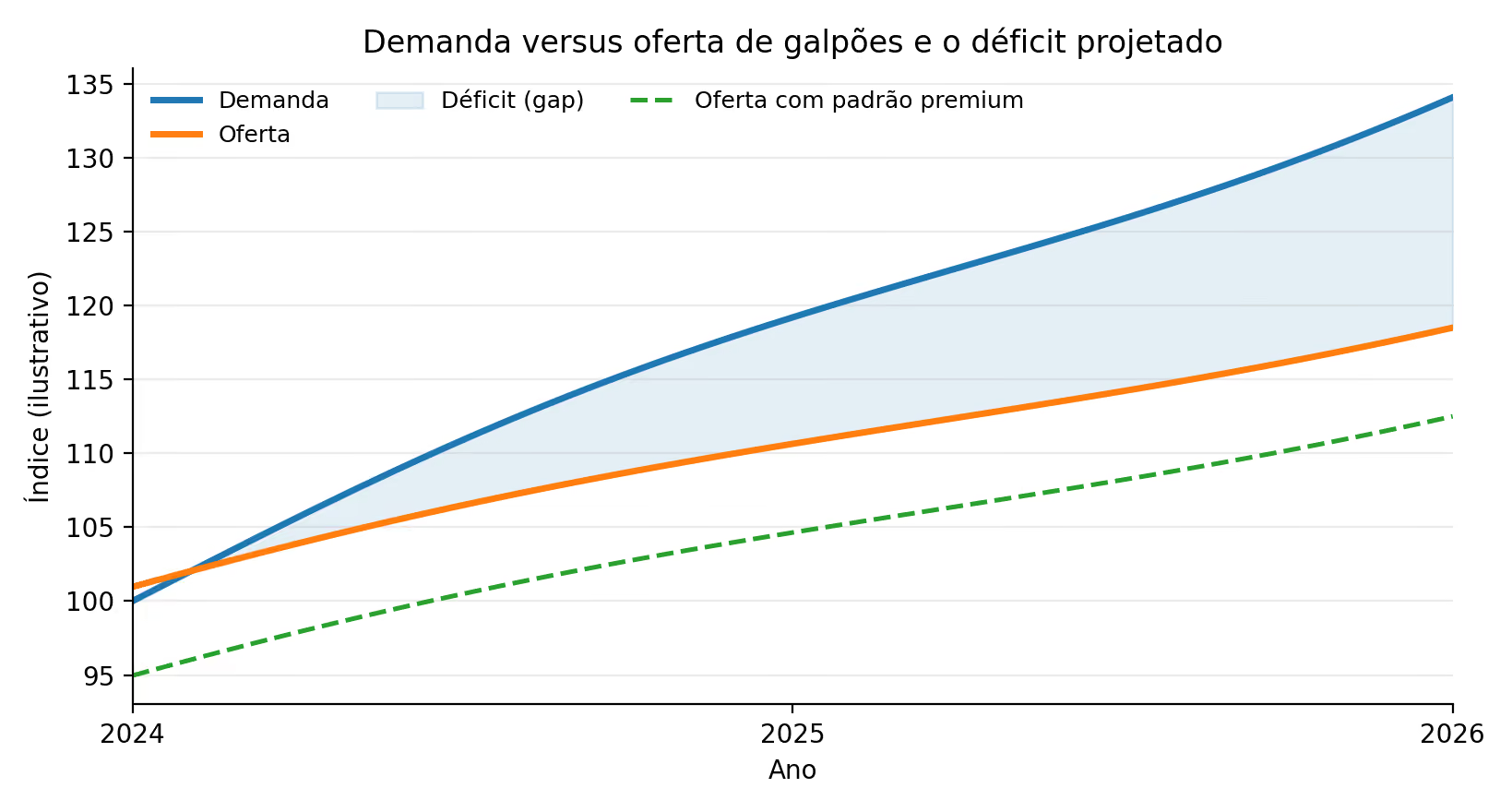
The projected deficit helps frame the discussion. A survey by the Erea Group estimates a gap of 500,000 square meters in 2026. This number alone is striking. The most relevant point, however, lies in the nature of this deficit. The market is not just competing for space; it is competing for quality stock—the kind that meets current standards for productivity, safety, energy, automation, and ESG criteria.
Why an industrial warehouse is not just a logistics warehouse by another name
In recent years, e-commerce and the reorganization of supply chains have placed logistics warehouses at the center of the conversation. In an environment of scarcity and increasing technical demands, however, one segment tends to differentiate itself even further: the industrial warehouse.
The distinction is simple to explain and profound in its implications. While a logistics warehouse is designed for distribution, an industrial one is designed for production. Production means processes, machinery, energy, operational continuity, thermal stability, enhanced security, and specific technical requirements that cannot be improvised.
That is why the barrier to entry is higher. And that is also why, when well-structured, the asset tends to be more resilient over time, with lower price elasticity and greater adherence to long-term contracts and occupancy.
What defines a true industrial asset, and why it matters for return and risk
When the occupant is an industrial operator, the quality of the asset ceases to be an aesthetic differentiator and becomes part of the cost of business interruption. In practice, some elements become decisive:
- Flooring and load capacity: Industrial operations may require floors that support 6 to 30 tons per square meter, which enables production lines, heavy equipment, and technical storage. This requirement alone eliminates a large portion of existing stock.
- Energy as infrastructure, not a commodity: The availability and redundancy of energy take center stage. The occupant is not just looking for sufficient energy; they are looking for a reliable source and security. Electricity, solar power, natural gas, and biomethane become decision factors, both for environmental goals and operational predictability.
- Location connected to the Brazil that exports and needs speed: In industrial real estate, logistics does not disappear; it changes its role. Proximity to major airports and ports favors chains that deal with higher value-added products and strict deadline requirements. Furthermore, these complexes usually radiate economic impact over a wide area, connecting labor, suppliers, and distribution.
- Tenant profile and relocation costs: Robust industrial occupants, multinationals, and large national companies in sectors such as pharmaceuticals, cosmetics, food, technology, and auto parts often invest amounts inside the warehouse that frequently exceed the cost of the property itself. This tenant capex creates a direct effect. Moving is expensive, time-consuming, and risky, which tends to strengthen retention.
- Lower price sensitivity than the market imagines: For companies with complex operations, rent represents a small fraction of the total cost. What matters is efficiency, continuity, and service. Armed security, 24-hour fire brigades, access control, and operational standardization can be more relevant than small variations in the price per square meter. For the investor, this usually translates into higher quality revenue, provided the asset is well-specified and well-managed.
2026 Outlook: interest rates, REITs, and the smart return to real estate
The prospect of falling interest rates tends to rebalance the competition between fixed income and real assets. In cycles where interest rates are trending downward, investors return to seeking predictable cash flow, wealth protection, and the potential for capital gains. This puts real estate investment trusts (REITs) back in a competitive position, compounded by the effect of taxation that has historically been more favorable to REITs compared to other financial alternatives for individual investors.
Investors, however, need to distinguish between a good thesis and poor execution. Industrial warehouses can be an excellent thesis, but they require discipline in underwriting, careful assessment of technical risk, credit analysis of the tenant, and, above all, specialized management to extract value and mitigate surprises.
How inVista views the industrial warehouse thesis
At inVista, our approach to industrial real estate is the same one that guides every asset class. We view property as a financial asset with a physical foundation, where returns are a direct function of specifications, contracts, credit, location, and management quality.
This explains why partnerships with specialized operators make a difference. When management combines a capital-focused vision with on-the-ground operations, the asset ceases to be just a warehouse and becomes a platform for services and expansion. In the industrial sector, this is even more relevant, because what the tenant is actually buying is continuity, compliance, and efficiency.
Within this context, the thesis is supported by three main pillars:
- Real barriers to entry, whether technical, capital-related, or regulatory
- More resilient tenants with high switching costs and a consistent focus on quality
- Demand for modern inventory in a market that is already showing a projected deficit for high-standard assets
For those investing through real estate funds, the key is to select strategies with robust governance, technical due diligence, and origination capacity. It is not enough to simply be exposed to warehouses. It is essential to be exposed to the right warehouses, with the right tenants, in the right structure.
What investors should look for before increasing exposure
To turn this thesis into an allocation decision, it is worth following an objective checklist:
- Does the asset meet actual industrial specifications, or does it just look industrial?
- What is the actual floor load capacity, and which certifications and reports verify this standard?
- What is the energy matrix like, and what level of redundancy is available?
- Who is the tenant, what sector do they operate in, and how critical is that site to their operations?
- What is the tenant's exit cost in terms of time, capex, and operational risk?
- Is there active management capable of increasing revenue, raising service standards, and extending the economic life of an asset?
- Does the contract protect the investor in stress scenarios, with well-defined adjustments, guarantees, and obligations?
2026 may reward those who understand quality before the market does
If the projected deficit is confirmed, the competition won't be for just any space. It will be for assets capable of delivering the technical standards, power, location, and services compatible with modern industry. In this environment, industrial warehouses tend to consolidate as a strategic asset, both due to occupant resilience and high barriers to entry.
At inVista, our conviction is pragmatic. Investors seeking consistency need a clear thesis, an appropriate structure, and qualified management. It is this combination that turns bricks into performance, through governance, discipline, and a long-term vision.
If you would like to discuss how industrial warehouses and other real estate theses can form a robust strategy for the coming cycles, contact inVista: ri@invista.me
DISCLAIMER: Informational content. Does not constitute a recommendation, offer, or solicitation to invest.
inVista Real Estate Insights is a biweekly series from inVista Real Estate that offers strategic insights and reflections on the future of the real estate sector, based on in-depth analysis and global market intelligence. Led by managers with 25 years of experience and a proven track record in over 23 countries, our newsletter is dedicated to investors seeking security and profitability, helping to build the future of the real estate market, brick by brick.
